Outrunning Oversight (Part 1)
“We’re blocked on how much humans can absorb.” That one line exposed our biggest blind spot: agent throughput looked healthy while human comprehension quietly fell behind, invisible until something broke.
That line should not have been the most honest thing anyone said in that room.
The fix wasn’t a better dashboard. It was seeing “the team” as two systems with different scaling curves, and tracking them separately.
Two layers, two scaling curves
Here’s the structural mismatch.
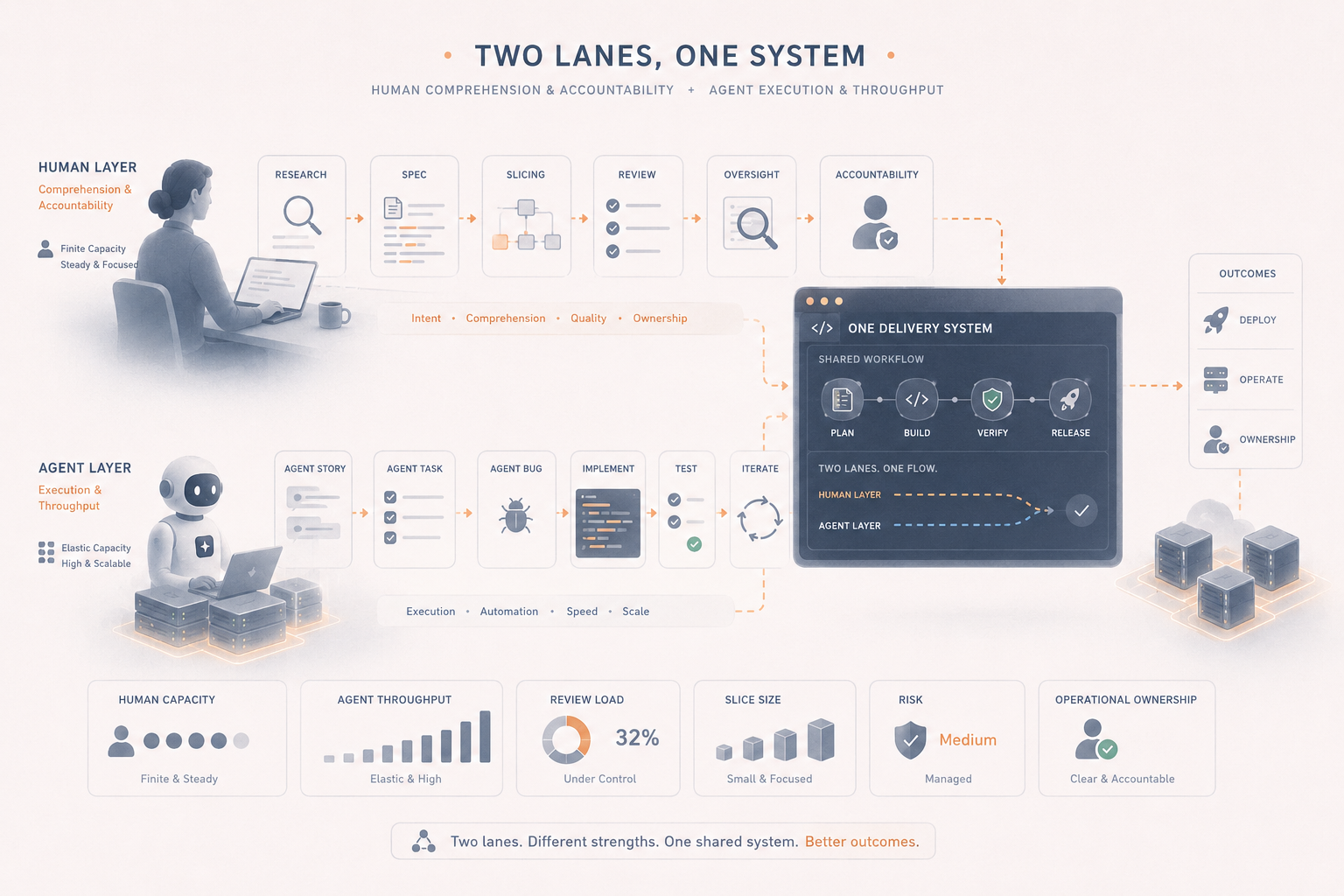
Human Layer: Intent and oversight. Problem shaping, slicing, review, accountability. Fixed capacity per person: hiring more reviewers helps, but no individual comprehends twice as much per hour just because agents got faster.
Agent Layer: Execution. Implementing slices, running tests, iterating on failures. Elastic capacity. More compute, more agents, better models directly increase throughput.
| Aspect | Human Layer | Agent Layer |
|---|---|---|
| Core activities | Research, Spec, Slicing, Review, Oversight | Agent Story, Agent Task, Agent Bug |
| Optimizes for | Comprehension and accountability | Throughput and correctness |
| Scales with | More reviewers, smaller slices, tighter WIP limits | More agent capacity (compute) |
| Bottleneck symptom | Spec ambiguity, review queue growth, rubber-stamping | Rarely the constraint once agents work |
The key mistake: treating both layers as symmetrically scalable. “Add capacity where needed” works for agents; for humans it backfires.
You can’t buy your way out of a comprehension bottleneck. Clearer specs come from understanding, not pressure.
Why a single backlog hides problems
Let’s talk about what happens when you collapse both layers into one backlog.
Collapsing both layers into one backlog creates three blind spots:
- Misleading velocity. High agent output looks like high team output, regardless of whether humans actually reviewed it.
- Invisible review debt. The backlog is not unshipped tickets. It is unverified understanding. Standard boards do not show this until something breaks.
- Wrong fixes. Teams add agent capacity when the real constraint is human review bandwidth, or push spec writers when slices are simply too big to review.
This isn’t hypothetical. CircleCI’s 2026 data showed feature-branch throughput up 59% year over year. Main-branch throughput for the median team actually fell in the same period.
The MindStudio team calls this the piling problem: the upstream stage (the agent) is dramatically faster than the downstream stage (human review). Unlike a traditional pipeline, the agent keeps producing regardless of the backlog growing behind it.
Separate tracking gives each layer its own metrics.
Human Layer metrics: Spec Completeness (100% pre-slicing), Pre-Eval Pass Rate (>80%), Review Approval Rate (>85%), Orchestration Latency (<25% of cycle time).
Agent Layer metrics: Agent Work Cycle Time (<4h/story), Post-Eval Pass Rate (>80%), Prompt Refinement Rate (<10%), Agent Utilization (>80%).
Example diagnosis: High Agent Utilization plus falling Review Approval Rate with rising Review Throughput means agent output is exceeding human absorption. Add rising Intent Debt Rate and it means specs are not guiding agents well, making output harder to verify. These require different responses: more reviewers and smaller slices versus better upstream problem understanding.
The closed-loop flow
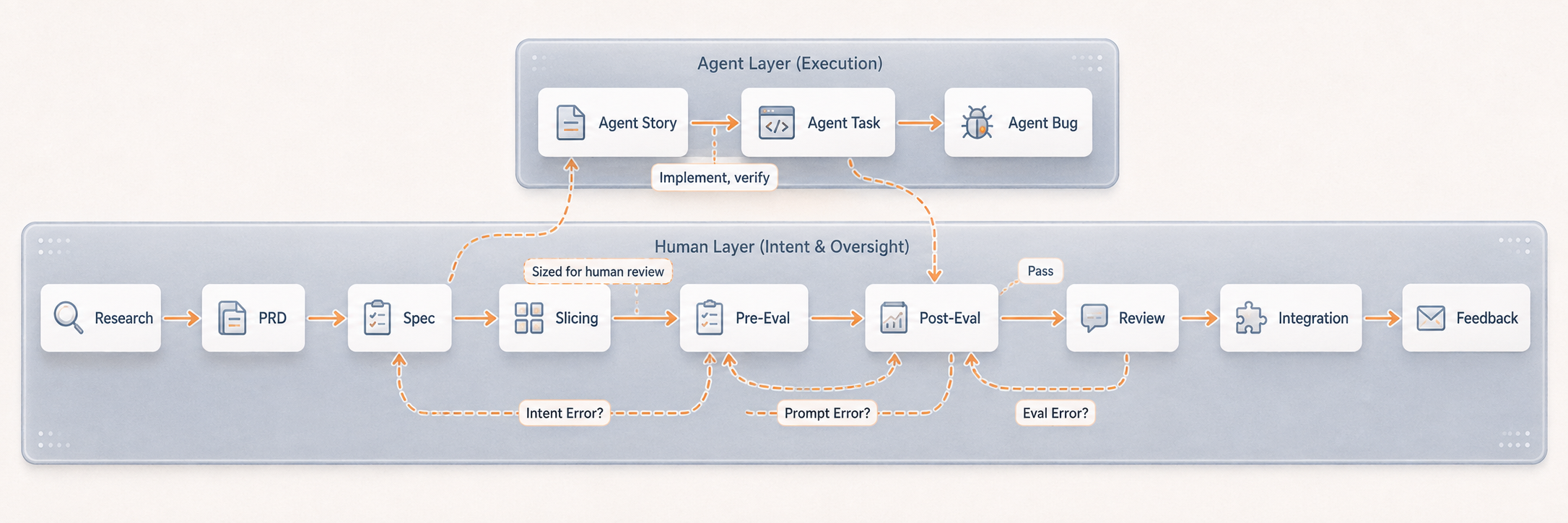
The flow is simple: Slicing feeds work to agents sized for human review. Agents implement and verify. Post-Eval routes failures back to their root cause (intent, prompt, or eval) rather than shunting them to Review. Only verified work reaches human Review, which feeds into Integration and Feedback.
Routing failures upstream prevents rubber-stamping. Ambiguous specs go back to Spec Owners. Unclear prompts become narrow refinement tasks. Slices do not return to Review until the root cause is fixed. This turns oversight from a gatekeeper into a diagnostic tool.
Escalation triggers determine when human review is needed:
- Action value: What is the cost of this action going wrong? Map by reversibility first, then magnitude. Irreversible and high-magnitude always escalates.
- Confidence threshold: A calibrated model at 94% confidence is materially different from one at 61%. Confidence-triggered escalation reduces noise dramatically compared to hard action-category rules.
- Anomaly detection: An agent that normally sends 5 to 10 emails suddenly attempting 400 should escalate regardless of confidence. Statistical outliers are a strong signal.
- Regulatory or data classification: Actions touching regulated data or crossing compliance boundaries require review by definition.
Capacity planning: arithmetic, not guesswork
Separating the layers turns sizing from a guessing game into basic math.
Human Capacity = (people) x (hours/week) x (availability %)
Required = (Spec + Pre-Eval + Post-Eval + Review + Orchestration time/story) x (stories/week)
Target: Required <= 70% of Human Capacity (buffer for spikes/rework)

Agent Capacity = (agents) x (stories/agent/week) x (quality %)
Required = stories/week
Target: Required <= 80% of Agent Capacity
Agent capacity rarely binds, since compute scales faster than review-capable teams grow. When required human capacity exceeds 70%, the fix is not “more agents.” It is throttling agent throughput (smaller slices, tighter WIP limits) until review catches up, or expanding the review bench.
Notice: Spec and Pre-Eval time appear in the human formula. The framework protects the whole human layer, not just reviewers, by throttling agent output to what the entire oversight chain can sustain.
Confidence calibration
Pass rates tell you what happened. Confidence calibration tells you whether your thresholds are right. A model that claims 94% confidence but only delivers 72% is wasting human review cycles. One that claims 60% but delivers 95% is over-escalating.
Calibrate empirically against your own production data. Derive escalation targets from your task distribution, not generic benchmarks. Use human corrections to tune evaluation prompts over time.
Human Layer metrics now include: Confidence Calibration Score (>90%), Escalation Rate (domain-specific), Human Override Rate (<15% of escalations).
Agent Layer metrics add: Prompt Confidence Score (>0.85 for auto-approved work), Confidence Discrimination (AUC >0.8).
Splitting the backlog is the enabling move for the rest of this series: it’s how you catch agent throughput outrunning human comprehension before an incident, not after.
We learned that the slow way, watching velocity charts look great for weeks before the first incident traced back to a review that was really just a glance.
The DORA 2025 report found that AI adoption boosts throughput but often harms stability, exactly the mismatch this framework is built to surface. Part 2 covers the five human judgment gates in this loop, and how to ration reviewer attention by risk instead of availability.
Up next: Part 2 (The Five Gates)